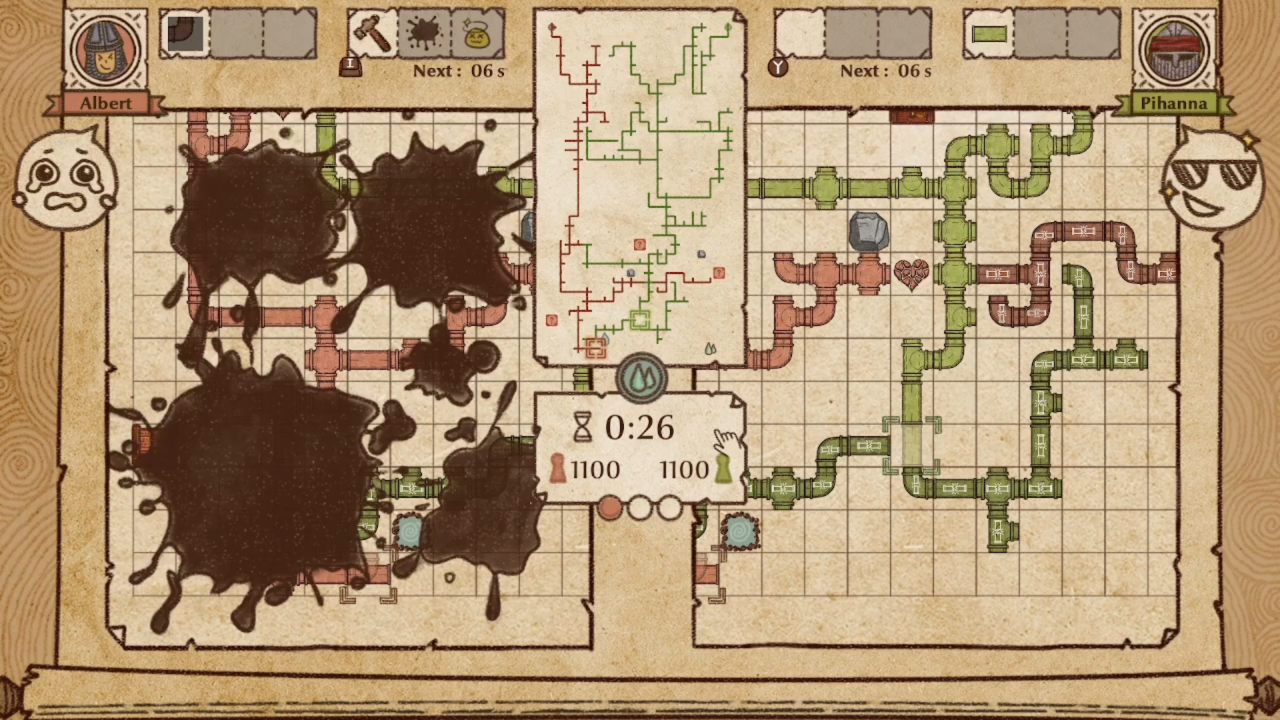
This is a two-player competitive game where you act as a lord, build pipes and compete with other countries to secure water sources for citizens. Save your country during droughts by building pipes, drawing water sources, and using various props to disrupt your opponent!
Project Type
2D Casual Competitive PC Game (developed in Unity)
Timeline
2023.7-2023.9 (1.5 months)
My Role
Project Lead
60% Game Design
100% Art
Skill & Tools
Adobe Photoshop, Paper prototype test, Player Research
Collaborators
Team of 4:
LONG Hongjian (Co-designer)
San Qi (Programmer)
Yonica (Sound Editor)
01 Intentions
My initial idea was to combine the visual satisfaction of connecting pipes with the chaotic fun of party games like Overcooked. To make the game look unique, I chose a medieval parchment art style. The main challenge was turning a solo puzzle activity into a thrilling battle. Pipe games are usually slow and solitary. We needed to make it fast, interactive, and easy for casual players to pick up.
02 Process
Through rounds of testing, we found several problems and fixed them:
1. Encouraging Interaction
At first, players focused only on their own boards and ignored each other. To fix this, we changed the rules so players could “kiss” and break their opponent’s pipes. We also added props like Bombs and Ink that let players attack each other directly. This made players watch their opponent’s actions and react, not just build alone.
2. Improving the “Falling behind” Experience
Early tests showed that once a player fell behind, they felt hopeless. To fix this, we changed the win condition from a single long race to dynamic rounds, giving players comeback chances. We also added a catch-up system that gives trailing players stronger offensive items like Bombs to help them fight back and keep the match tense.
3. Optimizing Pacing
We adjusted the map scale, made water goals appear dynamically instead of at fixed times, and used dynamic prop delivery speed to build rhythmic levels.
4. Helping Train
To help new players get onboard, we added a “Best-of-N” round system and AI bots with different difficulty levels so they could practice and enjoy the game.
03 Contributions
As Project Lead, I pitched the original idea, guided the vision, and managed the team by setting milestones, clarifying requirements, and coordinating weekly discussions.
As Game Designer, I created the core building rules. While I set the framework, many mechanics like winning rules and prop effects were refined through group discussions and playtesting.
As Artist, I established the visual style and produced all the art, including UI, map elements, and frame-by-frame animation in Photoshop.